Showing posts with label Crime. Show all posts

28/12/2014

Cops Don't Shoot People, Guns Do

I'm a fan of the right to keep and bear arms. But I prefer unarmed police and restricted gun rights to strong gun rights combined with a police force that regularly shoots civilians 'by accident'.
This is in the context of a discussion that uses the U.S. as an example of a country where cops bear arms as a default and New Zealand as an example of a country where they don't. The danger of police carrying guns is readily apparent given recent events and discussions about them in the U.S.: if they have guns, cops might use them all too often. I'm guessing a comparison of death by cop statistics between New Zealand and the U.S. would support that view.

But there's another important variable: the availability of guns to citizens. Apparently (based on information in the thread I link to above), it is pretty limited in NZ, whereas in some U.S. states, any Tom, Dick and Harry can buy a gun. Let me submit the theory that this is what really counts. I'm basing this view on a third data point: Germany. Here, cops routinely carry guns. If you play your music too loud at 10.01 p.m., the cops you'll find knocking on your door will be carrying fully loaded pistols. And yet, in 2011, police fired only 85 bullets while on duty (presumably not counting training), of which 49 were warning shots and 36 aimed at people; 15 people were injured and 6 killed. The numbers for 2010 were 96, 59, 37, 17 and 7, respectively.

Let me wildly generalize from that small heap of data and assumptions: When the probability is high that the other person has a gun, police will be quick to shoot. Part of this is split-second rational(ish) decision making, but there is also a wider institutional context in which this occurs - such as police guidelines about when to shoot and where to aim. The way to reduce police killings of citizens is hence to make it hard for citizens to bear arms.


28/04/2014

Social Scientist of the Month

The best answer in quite a while to the question, "Why do people look down on social scientists?" comes from Roger Matthews, professor of criminology at the University of Kent. The context is the idea that the removal of lead from gasoline may have played a role in falling crime rates, given that higher lead levels have been linked to aggression at the individual level. Here comes Matthews, as quoted by Dominic Casciani (via):
"I don't see the link," he says. "If this causes some sort of effect, why should those effects be criminal?

"The things that push people into crime are very different kinds of phenomena, not in the nature of their brain tissue. The problem about the theory is that a lot of these [researchers] are not remotely interested or cued into the kinds of things in the mainstream.

"There has been a long history of people trying to link biology to crime - that some people have their eyes too close together, or an extra chromosome, or whatever.

"This stuff gets disproved and disproved. But it keeps popping up. It's like a bad penny."
If you tried to come up with a parody of the daftness of those mushy-heads in the social sciences, could you think of anything better?

07/02/2014

Around the Blogs, Vol. 106


2. "Nonshared environment" might best be conceived of as noise, not environment, says Kevin Mitchell.

3. External validity alert: Are patients in medical trials selected for large treatment effects? (Andrew Gelman/Paul Alper)

4. Chris Bertram makes a surprisingly good case for the argument "Squeezing the rich is good: even when it raises no money".

5. "Is there no racial bias precisely because it seems like there is?" Ole Rogeberg takes us into the mind of the microeconomist.


8. 50 great book covers from 2013, collected by Dan Wagstaff (via)

9. The low-hanging fruit of immigration: Bryan Caplan offers another metaphor.


12. What's it like to hear voices that aren't there? (Christian Jarrett/L. Holt and A. Tickle)

02/12/2013

A Quick Test of the Matt Yglesias Hypothesis on Density and Crime

I’ve recently come across a 2011 post by Matt Yglesias (via, via) in which he presents the following little theory of population density and crime:
higher density helps reduce street crime in an urban environment in two ways. One is that in a higher density city, any given street is less likely to be empty of passersby at any given time. The other is that if a given patch of land has more citizens, that means it can also support a larger base of police officers. And for policing efficacy both the ratio of cops to citzens and of cops to land matters. Therefore, all else being equal a denser city will be a better policed city.
While plausible, this is also somewhat surprising because in the past people have come up with ideas on how density might increase crime. Which is not too surprising given that there is a positive correlation between density and crime (denser cities have higher crime rates). A while back, I half-heartedly reviewed the literature on this; people seem to have come to the conclusion that there’s not a lot to it. But that would suggest the effect is (close to) zero rather than negative.

As it happens, I have a dataset for 125 U.S. cities sitting on my hard drive. So let’s run some quick regressions. All are weighted by a variable that divides 1990 population size by the unweighted sample mean for 1990 population size. That means that each city is given a weight proportional to its size while the sample size stays the same; as a consequence, each crime has the same influence on the results irrespective of whether it happens in a small or a large city. While Yglesias writes in the context of having been assaulted, I will not use data on assault, which seems not to be particularly valid, but rather robbery, as official robbery rates appear to correlate highly with the true rates and robbery is the prototypical street crime. I use 1990-2000 changes in density per square mile and changes in robberies per 100,000 population known to the police as the variables of interest. The use of change data takes care of stable differences between cities that may contaminate the results. The estimation method is linear WLS of changes in (untransformed) rates.

I am not going to go through the trouble of embedding tables in blogger, but simply report results for the variable of interest in the text. Bivariate regression: B = -.25 (p < .001), meaning that an increase in density of 1 person per square mile is associated with a decrease of .25 robberies per 100,000 persons.

Next, let’s worry about immigration. It is, unsurprisingly, correlated positively with density and there are some students of crime who think that immigration decreased crime rates in the 1990s U.S. While I don’t necessarily agree with this, let’s control for changes in the percentage of the population that is foreign-born anyway. This makes next to no difference: B = -.27 (p < .001).

This may mean that density reduces robbery, robbery reduces density, there’s a bunch of unmeasured variables that influence both, or a combination of the above. I am not going to solve that problem here. But what I will do is control for some initial conditions (i.e., 1990 levels of variables) that may influence both of our variables of interest. First, the robbery rate is particularly likely to decline where it is high, so let’s control for 1990 levels of robbery rates. Also, better economic conditions will tend to attract people (and hence increase density) and perhaps also foster future decreases in crime. So let’s throw in 1990 values for poverty and unemployment rates, as well as the median of 1989 household income. This leads to a substantial reduction in the coefficient: -.14 (p < 0.001).

Is that a lot? The mean of changes in population density is 579 per square mile with a standard deviation of 842; for changes in the robbery rate, those values are 366 and 345, respectively. If we were to interpret the coefficient of the last regression as causal, this would mean that, in the sample as a whole, increases in density averted 579*(-.14) = 81 robberies per 100,000 population, meaning that changes in density would be responsible for about a seventh of the observed decline in homicides robberies. That’s a lot.

Of course, you shouldn’t take these little analyses all that seriously. I haven’t worried about functional form or heteroskedasticity and the equation isn’t all that convincing as a causal model.

Still. File under “suggestive”.

22/11/2013

Pebbles, Vol. 45


6. Short research article: Evidence against the hypothesis that red sports clothing causes winning (Thomas V. Pollet and Leonard S. Peperkoorn). If I read that correctly, though, assignment is not random.

7. 15 types of movie posters (Houke de Kwant). Arguably, this is a rational business strategy. If you have a way of signaling "This is an action movie with lots of explosions", that's what you should do. After all, posters are marketing devices first.


12. Correlates of polygamy in Africa (James Fenske) (via)


23/08/2013

The Methodology of Positive Economics - Reversed

Leigh Caldwell, a behavioural economist, writes about microfoundations in economic models. Microfoundations means that you don't just talk about aggregate-level variables, but model the decision-making of economic agents (typically persons) in your theory, and develop the aggregate-level predictions on that basis. Caldwell correctly points out that homo oeconomicus isn't very realistic and that, consequently, microfounded theories based on the idea of homo oeconomicus are wrong.

He goes on to outline two typical responses to the critique that humans aren't the superrational decision-makers many economic models portray them as. One, actual people are pretty close to homo oeconomicus; two, let's forget about microfoundations. Caldwell suggests that instead economic models be built on more realistic microfoundations.

Between the two of us, Caldwell's the only economist, but I'll still try to make the case that the above is all besides the point. Naturally, it all leads back to Friedman (1953). The article - "The Methodology of Positive Economics" - is all about microfoundations. Friedman's point is simple: He doesn't care whether the microfoundations are correct, as long as they give the right macropredictions, and they often do. 

What Friedman doesn't tell you is this: Economic models are consistent with a lot of predictions, and hence a lot of microfoundations.

Let's take the economic theory of crime. If you ask economists, it starts with Becker (1968).* Among other things, the theory predicts that if the likelihood of being punished for a crime goes up, the volume of crime goes down, all other things equal. Ehrlich (1973) translated that into a microfounded model in which agents make decisions in part based on their rational calculations about the likelihood of being punished if they commit a crime. It's basically the same thing (frankly, I fail to see the point). Both models predict: Punishment up, crime down.

But it doesn't say by how much. And it's not just the economic theory of crime. All that mathematical modeling in economics is highly misleading: It looks exact, but all they'll really tell you is the direction of an effect. The rest is left to empirical estimation. 

You might think that's a big problem for economics, and compared to an ideal world of exact predictions, it is. But, in fairness, it's not as though the other social sciences deliver anything else. As far as I can see, all social science theory is about signs.**

Back to the example: If you can show that a rise in the likelihood of punishment leads to a reduction in crime, that's consistent with superrational decision-makers. It is also consistent with some decision-makers being superrational and all the other people not responding at all to the change in the likelihood of punishment. Etc. If you think it through you end up with something like the following: The finding is consistent with some of the people being sorta rational some of the time, and their effects outweighing the effects that are due to people behaving contrary to what the theory says. 

For Friedman and me, that's fine. Leave psychology to the psychologists.

But there is one very important consequence of all this: If your macro-level finding is consistent with a theory built on a microfoundation that assumes rational agents, this does not show many people act rationally in any substantial sense. This is important because economists like to argue otherwise, and soon you arrive at the stance that all drugs should be legal because drug addicts are rational. I'm open to the idea that all drugs should be legal, but a finding that increases in financial or nonfinancial drug prices decrease demand does not provide a strong argument in favour of legalization. If you want to argue individual decision making, bring individual-level data.

Note. All cites from memory. And not even a list of references!
____________
*Of course, the ideas formalized in Becker's theory had been around for centuries, even in writing. E.g., Cesare Beccaria.
**There's also quite a bit of "theory" in the social sciences that's not really theory in the sense of a system of falsifiable hypotheses. Sociology is big in this department.

22/08/2013

Around the Blogs, Vol. 101: Long Wait, Long List

Because I've been collecting for so long, it's so many links. Because it's so many links, I'm posting it early.

1. If the effect in question was found in a particularly small sample, should that strengthen or weaken your belief in the effect? (Eric Falkenstein) From the same author: A critique of Stevenson and Wolfers' happiness research.

2. Thoughtful, personal essay by Eric S. Raymond about the emotion and cognition of racism.

3. A body-mind theory of lefties and righties (Agnostic)

4. "Annals of Self-Refuting Tweets" (Jeremy Freese presents the American Sociological Association make an ass of itself)

5. Wie intensiv werden die Deutschen eigentlich von der eigenen Regierung ausgespäht? Man weiß es nicht. (Niko Härting) (via)

6. "A conservative estimate is that we’re spending a million dollars per year per terrorist, maybe more – that’s not even counting Iraq and Afghanistan." (Gregory Cochran)

7. The case against (eating lunch) outside (Matthew Yglesias) (via)

8. Matthew Desseem reviews Rififi.

9. Person fixed effects and psychological testing.

10. The theory that Marcia Lucas contributed more to Star Wars' quality than is usually acknowledged. (Fabio Rojas)

11. A discussion of reviewing and reviewers (with a focus on sociology) (olderwoman and commenters)

12. Is US violent crime actually down? Looking at non-police data. (Steve Sailer)

13. "William Boyd’s Taxonomy of the Short Story" (Will Wilkinson)

14. How not to get published. (Andrew Gelman/Brian Nosek, Jeffrey Spies, and Matt Motyl)

15. Getting the priorities straight (Foseti) (on this blog)

16. Male feminists: Demand and supply. (Nick Borman)

17. Real life cases of amnesia that are stranger than fiction. (Christian Jarrett)

18. Season of birth is endogenous (Eric Crampton/Kasey S. Buckles and Daniel M. Hungerman)

19. A model of how the internet works (Marco Arment) (via)

05/07/2013

DNA Testing and Suspect Strategies

Gregory Cochran writes:
Nowadays, inspired by programs like CSI and NCIS, many students want to become some sort of forensic scientist. The problem is that are very few such jobs. I have heard that there are something like 20 times more forensics graduates than openings. This is not really caused by an overall shortage of crimes, more by a shortage of interesting crimes. When some dirtbag stabs his old lady, after beating the shit out of her for years, caught while still gripping the bloodstained murder weapon, who needs CSI?
Indeed, one of the many big differences between fiction and nonfiction is that crimes in fiction are much more intriguing than crimes in the real world. Or perhaps I should say the portion of crimes that becomes known to the police. Students of crime like to assert that homicides are measured with little error, but nobody knows whether that's actually true, and I've been wondering for a while how many of the young children whose death is ascribed to the mysterious "sudden infant death syndrome" (a label, not an explanation) are actually homicide victims.

Be that as it may, real-world known homicides are rarely of the type with which DNA analysis will help. When a husband kills his wife, you'll hardly nail him by showing that his DNA could be found in their house. Or, closer to Cochran's example, take a case from Hanover that made the rounds in the German newspapers a while back. A German and an Italian got into a fight in a bar over whether Italy had won the World Cup three or four times (an obviously important question given that Germany has won it three times). The Italian went home, got a gun, and killed the other discussant. It seems like a bit of an overreaction on the part of the offender, especially given that he was right. Anyway, no DNA needed.

I wonder, though, whether the threat of DNA testing does help the police solve some crimes. One of the big mysteries surrounding crime is why, in countries in which you are not obliged to give information to the police once you know you're a suspect, suspects still often do. The standard police strategy seems to be to suggest to an interviewee, rightly or wrongly, that they have something connecting him (it's usually him) to the crime, and to further suggest that he can talk himself out of that connection. The possibility of DNA testing might come in handy in this respect, as it can potentially establish that a suspect was at the crime scene. And once he acknowledges that, interrogators have a foot in the door. 

Note, though, that this presupposes that presence at the crime scene is in question, so, again, this effect should be limited. I've never looked into a possible connection between DNA testing becoming available and clearance rates. At the time, though, I seemed to notice something: The typical defendant's strategy in rape cases appeared to change. Before DNA testing, it seems, defendants typically claimed that they did not have intercourse of any kind with the victim. After DNA testing, the standard strategy quickly seemed to switch to claiming that there was intercourse, but it was consensual. If my impression holds up when you look at the data, you could use these changes to estimate the something like the minimum percentage of cases which made it into court in which the defendant should have been found guilty. Someone else do it!

17/06/2013

Estimating the Effect of Helmet Laws on Cycling-related Injuries: You Can't Do It Like That

In some places there are laws that require people to wear helmets when cycling. One may wonder what effects these regulations have on injuries. That's a question a paper (open access) by Jessica Dennis, Tim Ramsay, Alexis F. Turgeon and Ryan Zarychanski is trying to answer. They use data from the Canadian provinces, some of which introduced helmet legislation for minors only, while in other provinces the laws apply to people of all ages, and yet others introduced no such legislation. Have a look at the basic data:


Red lines are for adults, blue lines for minors. The dotted lines indicate when the legislation was introduced. You'll note that the provinces differ in when they introduced the laws. There are no clear breaks in the trends when the laws are introduced. On the other hand:
The rate of hospital admissions for cycling related head injuries in Canada among young people decreased from 17.0 to 4.9 per 100 000 person years between 1994 and 2008 (fig 1⇓). In provinces that implemented helmet legislation, the rate decreased steeply between 1994 and 2003, the time over which legislation was implemented, from 15.9 to 7.3 per 100 000 person years, corresponding to a 54.0% (95% confidence interval 48.2% to 59.8%) reduction. In provinces and territories that did not implement helmet legislation, the rate of admissions for cycling related head injuries also decreased between 1994 and 2003, but to a lesser degree. The reduction in provinces without legislation was 33.2% (23.3% to 43.0%), corresponding to a decrease from 19.1 to 12.9 per 100 000 person years. Among adults, the rate of admissions for cycling related head injuries was low in all provinces and across all study years. Between 1994 and 2003, the rate of head injuries in adults in provinces with helmet legislation decreased by 26.2% (16.0% to 36.3%), a reduction from 3.0 to 2.2 per 100 000 person years, compared with a negligible increase in rates in provinces and territories with no legislation, from 2.7 to 2.8 per 100 000 person years.
That's the authors' preliminary, narrative analysis. They point out that other cycling-related injuries also decreased. The authors then make some data analysis decisions which I would describe as suboptimal. First, they run an interrupted time series regression for each province separately, adjusting for trends. Second, they do not differentiate between provinces in which the laws apply only to minors and those where they apply to all, on the basis that some other study found spillover effects of legislation aimed at young people on helmet use in adults. Third, they take as their dependent variable hospital admissions for cycling-related head injuries as a ratio of hospital admissions for all cycling-related injuries.

The authors estimate no significant effects and conclude that "the incremental contribution of provincial helmet legislation to reduce the number of hospital admissions for head injuries is uncertain to some extent, but seems to have been minimal."

But you cannot conclude that from their analysis. First, recall that the provinces introduced their laws in different years. Dennis et al. throw that variation away and hence cannot control for time effects. Just pool the data and run a regression controlling for both province and year fixed effects! I guess that's almost all you need for identification, but one might consider controlling for differences in weather, which surely must have some effect on cycling.

Second, why not differentiate between laws applicable to all cyclists and minors only, respectively? Just use two different dummies. If the minors-only laws have effects on adults, that's information you want to explicate.

Third, and most importantly, you really, really do not want to adjust for all cycling-related injuries. The authors state that they do this in order to adjust for changes in cycling. But this makes no sense, and doubly so. (i) You automatically adjust-out any differences that the laws might make by reducing cycling. I believe there are studies suggesting such an effect, but I have not seen them. It would certainly make sense: Forcing people to wear a helmet makes cycling less attractive to some. (ii) There is a large literature on the topic of the consumption of risk (Peltzman effect). The idea is that when safety measures are put into place, people are going to consume some of that risk by adjusting their behaviour. For example, cyclists might cycle faster. So some of the effect of the law should be on cycling-related injuries not to the head.

In other words, this is an ideal design to find no effects even if there are some. I'm not saying that's deliberate - maybe it is more appropriate to say that this reflects disciplinary differences. For a medical researcher, it's probably natural to ask how much a helmet helps once there is an accident, which is roughly what the adjust-for-all-injuries strategy does. But if you measure that, you're not measuring the full effect of the law, which is the authors' stated aim. The concept of consumption of risk is standard knowledge in economics, and also known in other social sciences. And any undergraduate who has taken in, say, Wooldridge's Introductory Econometrics, should be able to suggest the design I outlined above, especially given the yummy data structure. Maybe that's just not obvious if your training was in medicine.

In this case, and as a noneconomist, I'll say it's the (hypothetical) economists who get it right. Oh, and I don't think you should use significance tests with this data.

07/06/2013

That Rise in U.S. Crime [Edited]

The FBI released preliminary data on crimes known to the police in 2012. The New York Times will let you know only about a portion of the data. Their author Timothy Williams doesn't tell you that property crimes are down by .8%, but presents a story about how violent crime has increased by 1.5%. Then he find an academic who's willing to go into story time:
Joseph Pollini, another John Jay College professor, said that one possibility was that there were fewer police officers on patrol in some metropolitan areas that have cut spending sharply in recent years because of the recession.

“You’re dealing with depleted police resources,” he said of budget cuts that have caused a reduction in the size of nearly every urban police department.
That's a foolish statement to make even if the rise in overall crime were 1.5%, which it is not. That's because 1.5% is very little. It doesn't call for a big explanation. That's not to say that the rise in violent crime is uncaused, but rather, that you'll have a hard time explaining such a small rise. And, to reiterate, property crime is down (calling into question Pollini's police story). The tables I've found won't give you numbers for total index crimes, but given that property crimes known to the police are much more common than violent crimes (e.g., a ratio of about 8:1 in 2011), this means that the overall number of crimes known to the police is down, contrary to the impression you could get from reading the New York Times.

Of course, one might wonder how valid these numbers are in the first place. O'Brien (1996; gated link) concludes that changes in violent crime were measured with high accuracy between 1973 and 1992, and if the convergence between victimization and police data in more recent years (e.g., here, pp. 391-393) is anything to go by, one may think that the accuracy of police data has gone up rather than down. Taken together with other research, this literature leads me to believe that changes reported by the FBI are probably close to the true change rate for overall violent crime, robbery (+.6), burglary (-3.6), and motor vehicle theft (+1.3). Taken together, this still ain't much of a trend. 

28/01/2013

The Systemic Problem with Private Prisons

Alex Tabarrok links to an interesting NY Times article by John Tierney on the benefits of spending money on prisons vs. police. One thing I learned from it is that New York did not follow the general U.S. trend towards more and more imprisonment. Here's a snippet:
Dr. Ludwig and Philip J. Cook, a Duke University economist, calculate that nationwide, money diverted from prison to policing would buy at least four times as much reduction in crime. They suggest shrinking the prison population by a quarter and using the savings to hire another 100,000 police officers.

Diverting that money to the police would be tricky politically, because corrections budgets are zealously defended in state capitals by prison administrators, unions and legislators.

But there is at least one prison administrator, Dr. Jacobson, the former correction commissioner in New York, who would send the money elsewhere.

“If you had a dollar to spend on reducing crime, and you looked at the science instead of the politics, you would never spend it on the prison system,” Dr. Jacobson said. “There is no better example of big government run amok.”
There's been a lot of argument about private prisons focusing on whether they will treat prisoners too harshly, or perhaps too well. But perhaps the real problem is that when you have private prison companies you have created a lobby group that has an interest in keeping behaviours illegal and sentences long. It almost looks like U.S. politicians are on a mission to prove that the Marxists were right after all.

I wonder how much lower U.S. imprisonment would be if there were no private prisons.

19/01/2013

Around the Blogs, Vol. 90

The next few Fridays will bring another playlist, so let's empty out the Around the Blogs folder:


2. Attempts to answer the questions, "What is science?" and "What is love?", collected by Maria Popova.

3. How women think about love. (Penelope Trunk)

4. Let's Potato (Andrew Hammel and his brother).

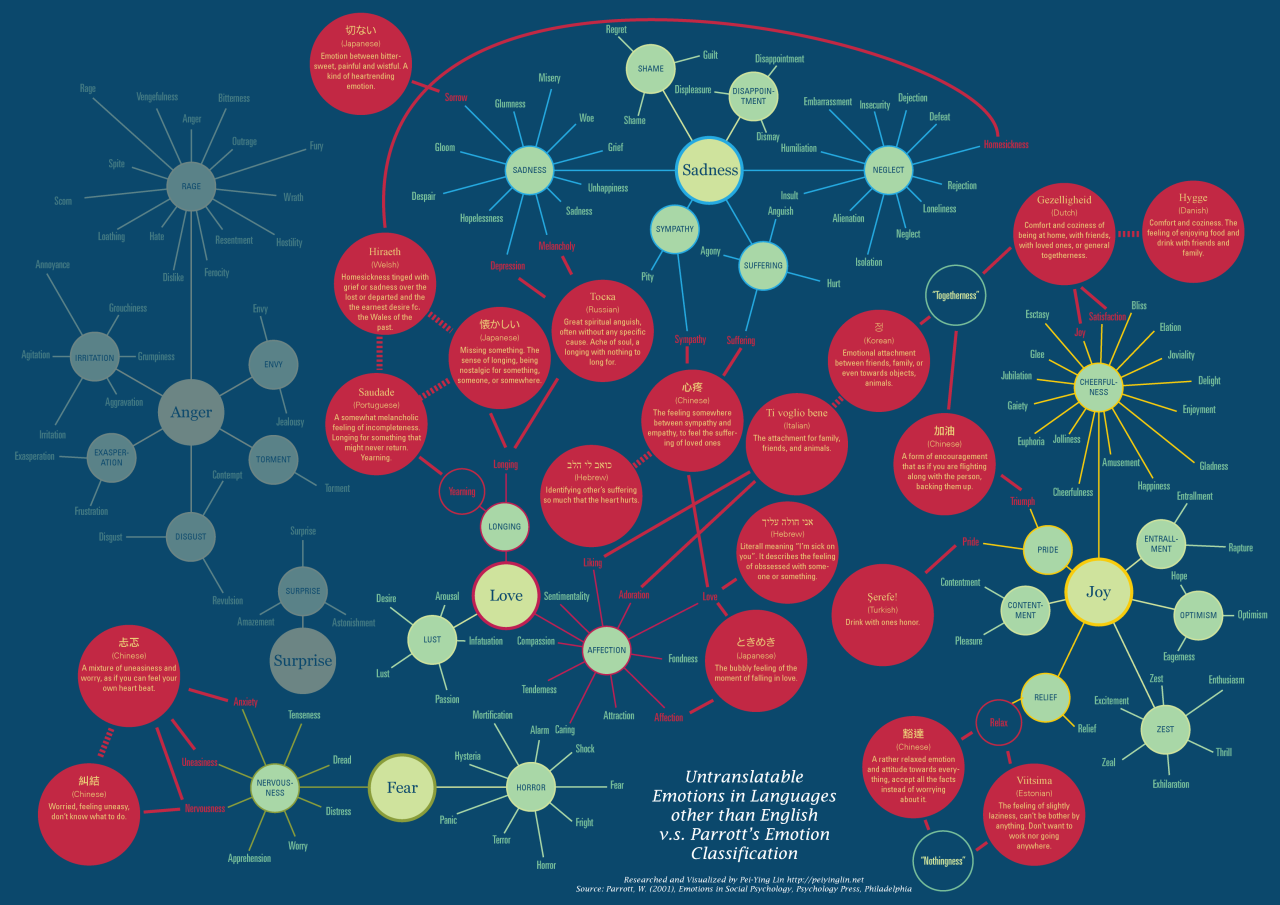
5. "Infographic Names 21 Emotions with No English Word Equivalents" (Erin McCarthy) (via). Large version of graph here. "Saudade" seems especially useful.


7. I want that drug! (Jon M)

29/12/2012

Operation Blank Slate, 2012 Edition

As usual, my end-of-the-year dump of stuff I meant to use for blogging but didn't. Shorter than usual because I changed machines mid-year and, much in the spirit of this series, didn't export bookmarks.

And coming on Jan 1st: The best blog posts of 2013.

24/12/2012

Around the Blogs, Vol. 89

Yeah, not a lot of original content lately; and given that it's the end of the year, readers should prepare for lots more listed-links-type of posts. Perhaps I'll get round to writing some original stuff over the holidays, but I doubt it. So, here's some noteworthy recent blog posts:


3. When outcomes for the treatment group affect outcomes for the control group, results won't scale up. (Economic Logician/Pieter Gautier, Paul Muller, Bas van der Klaauw, Michael Rosholm and Michael Svarer)

4. Perform your own meta-analysis (soon, perhaps) (passed along by Tyler Cowen)

5. A partial model of U.S. politics, from Andrew Hammel

Happy holidays, everyone.

31/10/2012

Not All Laws Are the Same

I'm glad to see that my internet acquaintance John Althouse Cohen is fine, despite living in southern Manhattan. In fact, his internet connection seems to be fine as well. He writes:
The traffic in the blackout areas of Manhattan is lawless in the most literal sense: the traffic lights aren't working, so the law cannot be applied as usual. But "lawless" doesn't seem to be a fitting description; the driving seems better-behaved than usual. We're so used to seeing people act under a system of government rules that it's easy to assume that without the rules, everything would descend into chaos. But perhaps free people are generally capable of acting decently on their own. Of course, that's never going to be universal; but then, people break the law too. In fact, a dense set of rules tempts people to see how close to (or how far across) the borderline of legality they can go without being penalized. In the absence of governmental laws, people might focus more on other kinds of laws: social norms and ethics. 
[Added: There actually is a law that applies when the traffic lights aren't working, but people probably don't know about that law, and they definitely aren't following it . . .]
Unsystematic evidence suggests that feelings of solidarity are particularly strong in the immediate aftermath of a common negative experience, with people on their best behaviour accordingly. Should Manhattan traffic lights continue to not work, I would expect drivers' level of care to slowly deteriorate. So perhaps one shouldn't draw too much of a conclusion from current driving behaviour to driving behaviour in the absence of traffic lights more generally. More importantly, though, I don't think you should generalize from the need for traffic laws to the need for laws, period.

One can draw up a taxonomy of lawbreaking by how much the involved parties are motivated to avoid an illegal act. Basically, there are three types. (i) Both parties are motivated to avoid; (ii) one party is motivated to avoid, one is not; (iii) none of the parties are motivated to avoid. Traffic laws are of type (i). Sure, it may be to your advantage to speed ceteris paribus, but you don't want to get into an accident. Even if it's the other guy who's dead, your fender may be a writeoff. So, by and large, you're motivated to more or less reach some type of agreement with other traffic parties about who goes where when. These types of laws are hence not that important. Laws of type (iii) are especially hard to defend. A standard example is selling/buying drugs. Presumably, if both parties want to do it, it's because they're aiming to maximize their expected utility. Such laws are not impossible to defend, but if you want to do so, you have some work on your hands.

The biggie is type (ii) - one party is motivated to avoid, the other's not. Examples of type (ii) lawbreaking include homicide, rape, robbery, assault, burglary and theft. Interestingly, these are the "core crimes" which seem to be proscribed in pretty much all societies, including ones without written laws, as long as the victim's an ingroup member. (I've read conflicting claims about rape, though.) One possible explanation for this finding is that societies in which such behaviour was allowed once existed, but are long gone, because life was so nasty, brutish, and short that sooner or later no members were left. 

If you want to move towards anarchy, please do away with type (ii) laws last.