Showing posts with label Films. Show all posts

18/08/2014

Spoiler Alert!

An hommage to Alfred Hitchcock's second best movie, by one Jeff Desom.


Those who prefer vimeo, look here.

22/08/2013

Around the Blogs, Vol. 101: Long Wait, Long List

Because I've been collecting for so long, it's so many links. Because it's so many links, I'm posting it early.

1. If the effect in question was found in a particularly small sample, should that strengthen or weaken your belief in the effect? (Eric Falkenstein) From the same author: A critique of Stevenson and Wolfers' happiness research.

2. Thoughtful, personal essay by Eric S. Raymond about the emotion and cognition of racism.

3. A body-mind theory of lefties and righties (Agnostic)

4. "Annals of Self-Refuting Tweets" (Jeremy Freese presents the American Sociological Association make an ass of itself)

5. Wie intensiv werden die Deutschen eigentlich von der eigenen Regierung ausgespäht? Man weiß es nicht. (Niko Härting) (via)

6. "A conservative estimate is that we’re spending a million dollars per year per terrorist, maybe more – that’s not even counting Iraq and Afghanistan." (Gregory Cochran)

7. The case against (eating lunch) outside (Matthew Yglesias) (via)

8. Matthew Desseem reviews Rififi.

9. Person fixed effects and psychological testing.

10. The theory that Marcia Lucas contributed more to Star Wars' quality than is usually acknowledged. (Fabio Rojas)

11. A discussion of reviewing and reviewers (with a focus on sociology) (olderwoman and commenters)

12. Is US violent crime actually down? Looking at non-police data. (Steve Sailer)

13. "William Boyd’s Taxonomy of the Short Story" (Will Wilkinson)

14. How not to get published. (Andrew Gelman/Brian Nosek, Jeffrey Spies, and Matt Motyl)

15. Getting the priorities straight (Foseti) (on this blog)

16. Male feminists: Demand and supply. (Nick Borman)

17. Real life cases of amnesia that are stranger than fiction. (Christian Jarrett)

18. Season of birth is endogenous (Eric Crampton/Kasey S. Buckles and Daniel M. Hungerman)

19. A model of how the internet works (Marco Arment) (via)

10/03/2013

Glück auf, Til Schweiger kommt: Die Tatort-Blitzkritik

Til Schweiger rennt, als ob er sich in die Hose gekackt hätte, und hat in weniger als fünf Minuten deutlich mehr als 10% der Kugeln verballert, die der deutschen Polizei pro Jahr zur Verbrecherbekämpfung zustehen, und man könnte auch sonst noch dies und das bemeckern, doch ich fand's knorke kurzweilig.

Ha, schneller als die Fernsehfreundin!

21/02/2013

From the Archives of LiberTrash

Via Eric Crampton comes a short 1978 libertarian propaganda film called Libra. It's unknown to imdb, but at the Smithonian, Matt Novak explains:
Produced and distributed by a free-market group based in San Diego called World Research, Inc., the 40-minute film is set in the year 2003 and gives viewers a look at two vastly different worlds. On Earth, a world government has formed and everything is micromanaged to death, killing private enterprise. But in space, there’s true hope for freedom.

The film explains that way back in 1978 a space colony community was formed using $50 billion of private funds. Back then, government regulations were just loose enough to allow them to form. But here in the year 2003, government regulators are trying to figure out a way to bring them back under their oppressive thumb through taxes and tariffs on the goods they ship back to Earth.
The film's fascinating to watch because it's a textbook case of how not to write a screenplay: The film ends just when one would expect the conflict to really get going; until then, it's little plot and lots of exposition - almost all of which is delivered by actors talking. Indeed, listening the agressively educational dialogues reminded me of the film Street Wise, which they made me watch in my first week at Anglia Polytechnic ("Hey, everybody, I won 50 quid at the pub quiz! I'm gonna put it on my desk in my room and not lock the door!"). There is one exception to this, however: Right at the beginning of the film, we see that New York City in 2003 looks exactly like New York City in 1978. We instinctively understand that this is due to guv'ment regulations stifling innovation in cars, clothing, and even hairdressing.

The entire film can be watched here. Recommended for fans of 70s trash and liberals who like making fun of the enemy.

29/12/2012

Operation Blank Slate, 2012 Edition

As usual, my end-of-the-year dump of stuff I meant to use for blogging but didn't. Shorter than usual because I changed machines mid-year and, much in the spirit of this series, didn't export bookmarks.

And coming on Jan 1st: The best blog posts of 2013.

05/08/2012

How (Not) to Use 'Best' Lists

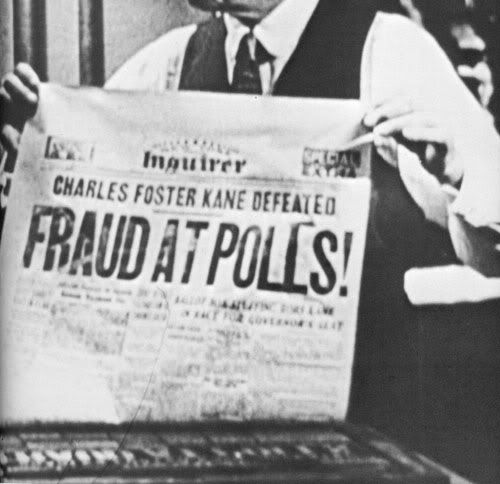
Fraud or not, I will not complain about Citizen Kane being kicked off the top of Sight&Sound's famous Greatest Films of All Time poll results table by a vastly superior movie. Having said that, I wonder why anyone might want to get worked up over this, as many people do. These kinds of polls don't measure objective greatness (which doesn't exist), but mere expert opinion. And no one's forced to sit through the whole list.

Having said that, some people do, probably out of some feeling that doing so is an achievement to be proud of. This strange practice is most beautifully exemplified by imdb commenter remurmur, describing his experience with the silent film serial Les Vampires:
For the record, I only watched Les Vampires due to being on the list of 1001 Movies You Must See Before You Die, which I am most diligently working my way through. [...]

It was one of the most difficult things I've ever forced myself to watch. At least it's silent, which allowed me to be productive in listening to about 7-8 albums from the 1001 Albums You Must Hear Before You Die list while Les Vampires caused my eyes to glaze over.
Man, you're doing it wrong! The actual use of these lists is that they might alert you to stuff you'll like that you would not otherwise have learned about. If the new Sight&Sound results cause one person to discover the not-that-well-known La passion de Jeanne d'Arc and love it as much as I do, it will have served a useful purpose.

10/07/2012

Film Review: Cosmopolis

The central metaphor in this one is the main character's asymmetric prostate. Which, through fuzzy semantics, is connected to his inability to act on information that cannot be forced into clear-cut calculations. If you don't believe me, go watch the movie yourself. Not that I'm recommending it.

06/03/2012

The Mystery of Holiday and Airport Reading

Americans have coined the term "airport reading" for books that are easy, trivial reads. Here in the more densely populated Europe, a more illustrative term would be "train reading". The phenomenon's the same, though: Just check any bookstore in a train station, and you'll find that the books they have on offer are easier reads than the ones on display in your average bookstore. A related phenomenon is holiday reading - again, these are books that are easier than the avearage book.

It is somewhat puzzling that one should choose easier reading for travel and holidays, as has been noted by quite a few authors over the years. For example, Andrew Gelman writes: "I’ve never really understood the idea that a 'beach read' should be something light and fluffy. On the beach, you can relax, you have the time to get into anything." Likewise, I find a silent long-distance train carriage the ideal reading environment, superior even to a silent home. (Admittedly, not all train carriages are silent.) So why should station's book stores carry more trivial matter?

I guess this way of looking at things is an instance of the within-between fallacy: You look at your own reading choices on the beach or train and conclude that beach and train reading should be harder, not easier, books. But actually, a different kind of selection is going on. Beach and train reading is mainly reading by people who otherwise don't read a lot. That is, we are not talking of cases in which an easy book is chosen instead of a harder one, but those in which a book is chosen instead of none. Naturally, such choices will be slanted towards the easy-to-consume. Regular readers actually take the demanding stuff on trains and holidays.

But that seems to make the wrong prediction about the books on offer in the station's book store: we should expect the station's store to carry books that are about as demanding as those in a regular store; furthermore, we expect some of the really tough stuff on offer in the station. Yet they don't seem to sell much Joyce and Kant there.

I think this is explained by the fact that people who read regularly typically have quite a number of unread books at home, and will bring them. In contrast, people who don't read a lot think: "Got four hours to kill on the train, will pick up a thriller before departure." The train station's book store is hence dominated by the tastes of those who don't read regularly.

This suggests that these stores have been, and will be, hurt a lot by the new option of bringing your laptop to watch movies on it.

03/02/2012

Pebbles, Vol. 36

Your weekend reading:

1. In praise of economic inequality (Paul Graham)

2. Harald Martenstein über das Sammeln von Büchern

3. Killian Fox explains pretty well why 2001 is the best film ever made.

4. "Unfortunately, bypassing the need to articulate the conditions and assumptions on which validity of the construct rests, may lead to bypassing consideration of whether these conditions and assumptions legitimately apply." The Deceibo Effect (Beatrice Golomb)

5. Are false rape accusations widespread? (Wendy McElroy)

6. Carreer advice: How to selectively report procedures and findings for publishability in psychology journals. Short, accessible academic paper (pdf) by Joseph P. Simmons, Leif D. Nelson and Uri Simonsohn.

7. What is it like to have an understanding of very advanced mathematics? (via)

8. Environmental catastrophe forecasts that didn't pan out. (Maxim Lott)

9. Insanity as rational choice given unusual preferences. Academic paper (pdf) by Bryan Caplan; of philosophical interest.

10/01/2012

Best Blog Posts of 2011, Vanity Edition

Yeah, I know, one is supposed to do this kind of thing while the old year is still on, but I didn't want to publish three linklists in a row. Anyway, here are ten posts from 2011 that I found more worthwhile than most, in no particular order.
As for "popular", I don't know, if by "popular" you mean "liked by many". Concerning traffic, it seems that's largely driven by how close to the top the post comes in on Google (relative to searches for that term, I guess). If you want to increase your blog's traffic, I suggest you write a post the title of which combines the terms "10,000 hour rule", "best alternative rock songs" and - surprise entry at no. 3 - "Bruno Gröning".

23/12/2011

Auteurs in Film and Academia

Last night I watched Easy Riders, Raging Bulls, the documentary about New Hollywood based on Peter Biskind's book of the same name. A main point I take away from the film (and which I don't remember taking away from the movie) is that maybe giving directors more or less complete control may not be such a good idea after all. The narrative is that it worked for a few years, giving us The Conversation and Taxi Driver; but then, the treatment directors received, coupled with excessive cocaine consumption, got to their heads, which gave us films like Scorsese's New York, New York (I haven't seen that one, but there seems to be a general agreement that it's, um, not a masterpiece.). The general argument need not be restricted to U.S. cinema. I certainly wouldn't have minded if some money men would have told Godard, "Er, Jean-Luc, can't you give us something that's a little more À bout de souffle?"

So perhaps artistic freedom isn't that hot after all. From a theoretical standpoint, that shouldn't be too surprising. Artists are good at creating original ideas and are almost bound to exhibit a certain amount of self-absorbtion; moreover, going against the grain is pretty much part of the job description. No wonder they'll pursue crap ideas from time to time, scoffing at the proles' ignorance.

I am writing this as I am in the middle of revising an article for resubmission. (In fact, I'm procrastinating). The main insult challenge is to cut its length by about 30%. No fun. But then, would I rather read a shorter or a longer article? Well, we all know the answer to that one. If you think that peer-review is the work of the devil whenever you're on the receiving end, but think, "Thank god there's peer-review" whenever you're asked to act as a gatekeeper, be aware that there's an inconsistency.

26/10/2011

Not a John Holmes Biography

I thought that the distinction of The Worst Translation of an English Book Title into German would forever belong to the person that had the splendid idea to translate Sense and Sensibility as Sinn und Sinnlichkeit. The latter's most obvious translation back into English would be Meaning and Sensuality. Other back-translations would also be possible, but an argument about that would presuppose an idea about what the person responsible had in mind when he or she came up with that one. Other than sound, I mean.

But I have now learned that the German publishers of Chris Anderson's The Long Tail had the good sense to keep the original title and add, as a literal German translation, Der lange Schwanz (as well as two additional subtitles). That translation is not, strictly speaking, wrong, but at least in the general readers that the book is aimed at it is bound to conjure up the image of the gentleman I mention in this post's title.

If we broaden the competition to any medium, however, that prize is still held by the German distributors of the film Mo' Money.

14/10/2011

Short Friday: Tairiki Taro No Mucha Shugyo (1928)

Another one from Japan. Manages to pack a lot of violence into 90 seconds, and a killer soundtrack, too!


And with that one, this series concludes. It may resume at some point in the future, but before, I'll have to watch a few more public domain shorts.

30/09/2011

Short Friday: Manhatta (1921)

Even to call this short a documentary would be misleading. It is, rather, a moving picture in the literal sense of the word, to be looked at as though it were a photograph. The cards show quotes from Whitman's Leaves of Grass (10 mins.).