Showing posts with label Natural Sciences. Show all posts

11/01/2015

Genetics, Human Capital, and the Thomas Theorem

In this short presentation on "Genetics and Society" (video), Gregory Cochran points out an obvious incompatability between human capital theory and empirical findings in behaviour genetics: Human capital theory proceeds as though differences in human capital were solely the product of environmental influences, and especially decisions made by parents, but this is known to be false. Cochran goes on to say this has an impact on a point made in human capital theory concerning the quality-quantity tradeoff: The standard view is that you can have many kids and low investment per kid, leading to relatively low human capital in each kid, or you can have many kids, invest heavily in them, and expect them to exhibit high human capital. To the extent that human capital is influenced by genetics, and to the extent that it is not influenced by parents, this tradeoff does not exist. For example, IQ shows practically no response to differences in parental behaviour, hence your kids' expected IQ is independent from your investments, hence independent from the number of kids you have.

But that's a normative point. Empirically, how much people plan to invest in their kids and how many kids they hence choose to have, should be influenced not by the truth itself, but by what people believe to be true. Belief in genetic influences on people's characteristics decreased ca. 1920-1950 and is now low. While research results from the 1970s onwards have shown the popular view to be wrong, these results are not widely known and believed. Hence, decreases in the number of kids people have might still in part be explained by the above-mentioned aspect of human capital theory, if it is combined with the Thomas theorem: "If men define situations as real, they are real in their consequences."

12/10/2014

Biological Reality of Race? What Does It Even Mean? (Also: Free access to Sage journals)

Via Dan Hirschman at Scatterplot comes a debate in Sociological Theory about the nature of race: is it social and/or biological? The new contributions consist of three critical reactions to an article in the 2012 volume of the same journal by Jiannbin Lee Shiao, Thomas Bode, Amber Beyer and Daniel Selvig called "The Genomic Challenge to the Social Construction of Race", and a rejoinder by Shiao. 

The topic isn't new, and the sub-exchange between Shiao in one corner and Daniel Martinez HoSang in the other confirms what something I've long been thinking about this.  

As you may know, variants of cluster analysis can be used to group individuals' genomes on the basis of similarities and dissimilarities, and it has been shown that the resulting clusters correspond to racial categories, as measured by self-identification, for example. One of the two main arguments in the initial Shiao et al. paper is that this clearly shows that the view that race has no biological basis, held by so many sociologists, is wrong.

HoSang's article ends in an attempt at character assassination that stops just short of holding Shiao et al. personally responsible for the gas chambers in Auschwitz, but the earlier portions actually have serious content. HoSang voices misgivings about the validity of the cluster analyses and their interpretation by Shiao et al. and others, but then goes on to say (p. 233):
And even if one accepts the (contested) finding that self-identified race or ethnicity correlates with population structure, this finding does not justify a conclusion that “race” (or clinal class) has a biological basis. At the most quotidian level, the findings suggest that a statistical analysis of genetic ancestry informative markers of a population in the United States that self-identifies as “black” is likely to bear a relationship to an analysis of populations sampled in some region of sub-Saharan Africa. And a population that self-identifies as Chinese is likely to be statistically related with a population in China (Dupré 2008). That a new statistical technique has validated a high probability of such histories of migration is hardly revelatory; it does not establish a biological basis of race.
But  Shiao et al. clearly think just that: These findings show that race has a biological basis.

I suggest that people who wish to have this debate take a step back and start by reaching an agreement on the following:

1. What does it means to say, "Race has a biological basis"? What does it mean to say "Race is a biologically meaningful concept"? Are the two the same?

2. What evidence, if it existed, would show that race has a biological basis/is a biologically meaningful concept? What evidence, if it existed, would refute those claims?

If you don't do that, you'll debate ad infinitum.

Added: Along similar lines, Fabio Rojas comments.

**************

By the way, you can download all of the articles above, as Sage allows open access to all of its journals until October 31st (registration required).

28/04/2014

Seth Roberts Is Dead

Today, from his siter Amy, via his blog, came the message that Seth Roberts has passed away. My condolences to his family and friends.

I never met him, only had a few exchanges with him on this and his blog. Generally, I felt he went to far in his criticism of standard approaches, and put too much weight on low-quality evidence. But, as long as I knew of his work - and I certainly include his blogging here - I valued him as an original, unusual, and stimulating thinker. I believe that once the great weight gain in affluent countries ca. 1970-present is better understood, his learning theory of the set point will be a large part of the explanation.

Here are posts in which I discuss Seths work (some of them quite critical):
Two of his posts made it onto my year-end "Best Blogposts of..." lists:
Here are quotes of his that I found worth keeping. Here is his paper on self-experimentation in Behavioral and Brain Sciences. Here is his paper "What Makes Food Fattening?" Blowhard, Esq. remembers. Ben Casnocha remembers. Andrew Gelman remembers.

09/04/2014

If You Make One Wrong Assumption, All Kinds of Shit Can Follow

From Steve Sailer's review of Gregory Clark's new book, The Son Also Rises (which I have not  read but might):
Economists [...] assumed that social mobility multiplies at the same rate with each new generation. If the correlation coefficient [...] of income between father and son is 0.4, then between grandfather and son it was imagined to be 0.4 squared or 0.16. Instead, it’s somewhat higher (0.26 in one study) due to regression toward the mean [...]. If a rich man has a son of only average income, his grandson is likely to earn somewhat above average.
This doesn't seem like such an advanced insight to come up with, so one might think that someone should have thought of it long ago and convinced all the others.

But then, it is not that surprising. Mainstream economics is a blank-slate science, as is the other discipline studying intergenerational mobility, sociology. To paint with a broad brush, the two differ in the timing of the influences they deem important. Standard economics sees everybody as basically the same, but subject to different opportunities and restrictions in a given situation. In contrast, sociologists typically think that people enter situations exhibiting vast differences, which result from social influences from birth onwards. Neither considers that large and important differences may already exist at birth (Hence, how could regression to the mean be important? What mean?).

This assumption has been known to be wrong for decades. Clinging to it causes all kinds of problems. Perhaps the main symptom of this in sociology is researchers' tendency to view a host of things as exogenous which are, in fact, endogenous. Such as, oh, socioeconomic status, the discipline's favourite variable. Once you realize there may be an endogenous component to status, you'll start doing lots of eyerolling when reading sociology journals. After a while, eyeache sets in.

07/02/2014

Around the Blogs, Vol. 106


2. "Nonshared environment" might best be conceived of as noise, not environment, says Kevin Mitchell.

3. External validity alert: Are patients in medical trials selected for large treatment effects? (Andrew Gelman/Paul Alper)

4. Chris Bertram makes a surprisingly good case for the argument "Squeezing the rich is good: even when it raises no money".

5. "Is there no racial bias precisely because it seems like there is?" Ole Rogeberg takes us into the mind of the microeconomist.


8. 50 great book covers from 2013, collected by Dan Wagstaff (via)

9. The low-hanging fruit of immigration: Bryan Caplan offers another metaphor.


12. What's it like to hear voices that aren't there? (Christian Jarrett/L. Holt and A. Tickle)

07/01/2014

The Best Blog Posts of 2013

It's about time, so here.

As usual, brackets are appended to each link to indicate whether the post is Long, Medium lenght or Short; High-Brow, Mid-Brow or Low-Brow, and Funny or Not.

For other years' lists, use the tag.


15. Offsetting Behaviour: "Social Costs and HPV", by Eric Crampton

14. Discover: "Why Race as a Biological Construct Matters", by Razib Khan (L; HB; N)

13. The Power of Goals: "Home Sweet Home", by Mark Taylor (L; MB; N)

12. Crooked Timber: "New Tools for Reproducible Research", by Kieran Healy (S; MB; F)

11. German Joys: "The Metamorphosis (US Summer Movie) Elevator Pitch", by Andrew Hammel (S; MB; F)

10. Code and Culture: "You Broke Peer Review. Yes, I Mean You", by Gabriel Rossman (L; MB; N)

9. EconLog: "The Homage Statism Pays to Liberty", by Bryan Caplan (M; MB; N)

8. Scatterplot: "Annals of Self-Refuting Tweets", by Jeremy Freese (S; MB; F)

7. Overcoming Bias: "Future Story Status", by Robin Hanson (M; HB; N)

6. Gulf Coast Blog: "Defamiliarization, Again for the First Time", by Will Wilkinson (L; MB; N)

5. Armed and Dangerous: "Preventing Visceral Racism", by Eric S. Raymond (L; MB; N)

4. Askblog: "It Is Sometimes Appropriate . . .", by Arnold Kling (M; HB; N)

3. EconLog: "Make Your Own Bubble in 10 Easy Steps", by Bryan Caplan (M; LB; N)

2. Armed and Dangerous: "Natural Rights and Wrongs?", by Eric S. Raymond (M; HB; N)

1. Falkenblog: "Great Minds Confabulate Like Small Minds", by Eric Falkenstein (L; HB; N)

Thanks and congrats to all above.

29/11/2013

Around the Blogs, Vol. 103

Bit late today, but here's some recent posts that may be worth your time.

1. Andrew Gelman knows how randomization works in animal studies. (Post starts off with disturbing image)

2. Gabriel Rossman has tips on how to be a better journal reviewer, with a focus on decreasing turnaround times. Fabio Rojas links and summarizes.

3. Christian Jarrett summarizes a new paper by Brian D. Earp, Jim A. C. Everett, Elizabeth N. Madva, and J. Kiley Hamlin, who cannot replicate the "Macbeth effect", i.e., the finding that feelings of disgust increase the desire for physical cleaning.

15/11/2013

Around the Blogs, Vol. 102

1. The experiment Milgram chose not to publish (Tom Bartlett/Gina Perry) (via)


6. Why people dislike photos of themselves: Mirrors meet the mere exposure effect (Robert T. Gonzales). But don't miss the link in the last paragraph.

7. 26 great words from the OED (Carolyn Kellogg/Ammon Shea)


11. Paging Quetelet: Why song lenghts are not normally distributed (Gabriel Rossman) (via)


13. Feelings of extreme bliss produced by targeted brain stimulation (Christian Jarrett/Fabienne Picard, Didier Scavarda, and Fabrice Bartolomei). Gimme, gimme, gimme!

14. Why wages don't fall during recessions (Bryan Caplan/Truman Bewley)


16. Another bonkers graphic presented by Kaiser Fung.

17. The impact on wages of: height; smoking; testosterone (Economic Logician/Petri Böckerman and Jari Vainiomäki/Julie Hotchkiss and Melinda Pitts/Anne Gielen, Jessica Holmes and Caitlin Myers).

14/11/2013

New Paper: At Least One Method for Estimating the Effect of Genes Yields Misleading Results

Until recently, behavioural geneticists had to use twin samples to estimate the heritability of traits. The standard method estimates heritability - the contribution of genes - by exploiting the fact that identical twins are more genetically alike than nonidentical twins, who are more alike than unrelated people. A drawback of this method is that twin samples are hard to find. Recently, a method has become available that circumvents this problem; it's called genome-wide complex trait analysis (GCTA). The basic idea is to use differences in the actual genetic makeup of people to calculate heritability. It should not be confused with the genome-wide association technique, which "hunts" for specific "genes for" some outcome (the "gene for depression" or what have you).

A recent paper by Maciej Trzaskowski, Philip S. Dale and Robert Plomin (abstract; via) compares heritability estimates on the basis of standard and GCTA techniques. Results for the dependent variables show that GCTA estimates are considerably smaller than standard estimates for height, weight and intelligence. The real shocker are the results for "behaviour problems" (such as depression or hyperactivity), though. While the standard analyses suggest considerable heritability, most GCTA estimates are zero or close to zero. Here's the result for self-report measures, with standard results on the left and GCTA results on the right:


Results for parent and teacher reports are broadly similar.

What's it all mean? Well, the authors include a long discussion section in their paper, but, frankly, much of it is above my head due to my very limited knowledge of genetics and associated research methods. The most important take-home message, though, is that at least one of the common methods for estimating the contribution of genes to human outcomes yields misleading results. This is very important, and it is to be hoped that the paper gets lots of exposure. I've done my part.

05/07/2013

Pebbles, Vol. 43


DNA Testing and Suspect Strategies

Gregory Cochran writes:
Nowadays, inspired by programs like CSI and NCIS, many students want to become some sort of forensic scientist. The problem is that are very few such jobs. I have heard that there are something like 20 times more forensics graduates than openings. This is not really caused by an overall shortage of crimes, more by a shortage of interesting crimes. When some dirtbag stabs his old lady, after beating the shit out of her for years, caught while still gripping the bloodstained murder weapon, who needs CSI?
Indeed, one of the many big differences between fiction and nonfiction is that crimes in fiction are much more intriguing than crimes in the real world. Or perhaps I should say the portion of crimes that becomes known to the police. Students of crime like to assert that homicides are measured with little error, but nobody knows whether that's actually true, and I've been wondering for a while how many of the young children whose death is ascribed to the mysterious "sudden infant death syndrome" (a label, not an explanation) are actually homicide victims.

Be that as it may, real-world known homicides are rarely of the type with which DNA analysis will help. When a husband kills his wife, you'll hardly nail him by showing that his DNA could be found in their house. Or, closer to Cochran's example, take a case from Hanover that made the rounds in the German newspapers a while back. A German and an Italian got into a fight in a bar over whether Italy had won the World Cup three or four times (an obviously important question given that Germany has won it three times). The Italian went home, got a gun, and killed the other discussant. It seems like a bit of an overreaction on the part of the offender, especially given that he was right. Anyway, no DNA needed.

I wonder, though, whether the threat of DNA testing does help the police solve some crimes. One of the big mysteries surrounding crime is why, in countries in which you are not obliged to give information to the police once you know you're a suspect, suspects still often do. The standard police strategy seems to be to suggest to an interviewee, rightly or wrongly, that they have something connecting him (it's usually him) to the crime, and to further suggest that he can talk himself out of that connection. The possibility of DNA testing might come in handy in this respect, as it can potentially establish that a suspect was at the crime scene. And once he acknowledges that, interrogators have a foot in the door. 

Note, though, that this presupposes that presence at the crime scene is in question, so, again, this effect should be limited. I've never looked into a possible connection between DNA testing becoming available and clearance rates. At the time, though, I seemed to notice something: The typical defendant's strategy in rape cases appeared to change. Before DNA testing, it seems, defendants typically claimed that they did not have intercourse of any kind with the victim. After DNA testing, the standard strategy quickly seemed to switch to claiming that there was intercourse, but it was consensual. If my impression holds up when you look at the data, you could use these changes to estimate the something like the minimum percentage of cases which made it into court in which the defendant should have been found guilty. Someone else do it!

07/06/2013

Around the Blogs, Vol. 98

1. Race as a biological and social construct (Razib Khan)

2. The case for taxing oral sex (Eric Crampton)

3. "My hypothesis is that progressives, conservatives, and libertarians view politics along three different axes." (Arnold Kling)

4. Don't try to become good at something (Ben Casnocha)

5. If you really set your mind to it, you can find unfair inequalities everywhere. Scatterplot's mike3550 shows how to.

6. "Want to Know What Someone Really Thinks?" (Gretchen Rubin) The case seems way overstated to me, but you may want to add that tool to your box.

7. Wikipedia's most controversial topics (Samuel Arbesman/Taha Yasseri, Anselm Spoerri, Mark Graham, János Kertész) (via). Who would have guessed that the most controversial topic in German Wikipedia is Croatia?

24/05/2013

Around the Blogs, Vol. 97: Heritability, Indians, Blotzheim [delete commas to obtain band name]

1. "The national news media appears to be turning into a giant conspiracy to feed me material." A rather funny post by Steve Sailer. From the same author: A good example of environmental influences on heritability (estimates), as a part of musings on the height of actors.

2. "Close friendships appear to counteract genetic vulnerability to depression in girls, but not boys" (Christian Jarrett/Brendgen et al.). Suggestive, but correlation-not-causation/endogeneity alert.

3. German name of the day (Andrew Hammel)

Enjoy your weekend!

10/05/2013

Around the Blogs, Vol. 96

1. Neurobonkers summarizes the results of a new review on the efficacy of learning techniques (via). Contains link to the full, open-source paper, but that's one long article, that is.

2. If the excerpt presented by Michael Blowhard Esq. is anything to go by, Seamus Heaney's translation of Beowolf into modern English is tasty.

3. How much benefit has the Human Genome Project brought so far? Says Roberts says meh.

4. ". . . the average free-market economist doesn't take the unemployment problem seriously", says free-market economist Bryan Caplan. And he's not happy about it.

04/02/2013

Three Quick Shots

1. If you like outlandish academic papers, how about "An examination of Rushton’s theory of differences in penis length and circumference and r-K life history theory in 113 populations" by Richard Lynn? Here's the abstract:
Rushton’s (1985, 2000) r-K life history theory that Mongoloids are the most K evolved, Caucasoids somewhat less K evolved, and Negroids the least K evolved is examined and extended in an analysis of data for erect penis length and circumference in three new data sets. These new data extend Rushton’s theory by presenting disaggregated data for penis size for European and North African/South Asian Caucasoids; for East Asian and Southeast Asian Mongoloids; for Inuit and Amerindians and Mestizos, and for thirteen mixed race samples. The results generally confirm and extend Rushton’s r-K life history theory.
Seriously, though, this paper is pretty uninformative for the same reason that most research on sex differences is pretty uninformative: It uses nonrepresentative samples.

2. A NY Times comment by Thomas Edsall (via) discusses disagreements about economic inequality. Basically, economists seem to have different opinions on whether consumption inequality is more important than income inequality, and if so, which consumption counts and how it should be measured. This illustrates a pervasive point about the inequality debate in both academic circles and society in general. Few people care about economic inequality per se; what they really mean is human well-being. But the psychological theory that would tell you how inequality translates into well-being is, basically, absent, and people work with implicit assumptions all the time. For example, if you think that consumption inequality is the only kind that matters, you are implying (whether or not you're aware of it) that nobody's ever suffered because his colleague down the hall earned ten percent more. Speaking of which, the concept of the reference group is old, but, unless I've missed something, social scientists have yet to come to a conclusion on what the relevant reference group for a person is. I suspect that has nothing to do with social scientists' laziness and a lot with reality not lending itself to a general answer.

3. Via Steve Sailer, here are some results from a study of the representation of women among authors of academic papers (the dots represent subfields within a discipline, such as "socilology of the family"):
You could explain the differences in representation between economics and sociology as a consequence of economics being much more mathematical than sociology, combined with the fact that women tend to be underrepresented where maths features heavily. Unfortunately, this theory runs into the immediate problem of women being underrepresented in economics even relative to probability and statistics. However, both observations are consistent with a two-step selection model. In a first step a person either does or does not go into a social science field, and in a second step, the more specific discipline is selected. This is basically the same explanation I've offered for why there are no romantic comedies for men. Well, sort of.

19/01/2013

Around the Blogs, Vol. 90

The next few Fridays will bring another playlist, so let's empty out the Around the Blogs folder:


2. Attempts to answer the questions, "What is science?" and "What is love?", collected by Maria Popova.

3. How women think about love. (Penelope Trunk)

4. Let's Potato (Andrew Hammel and his brother).

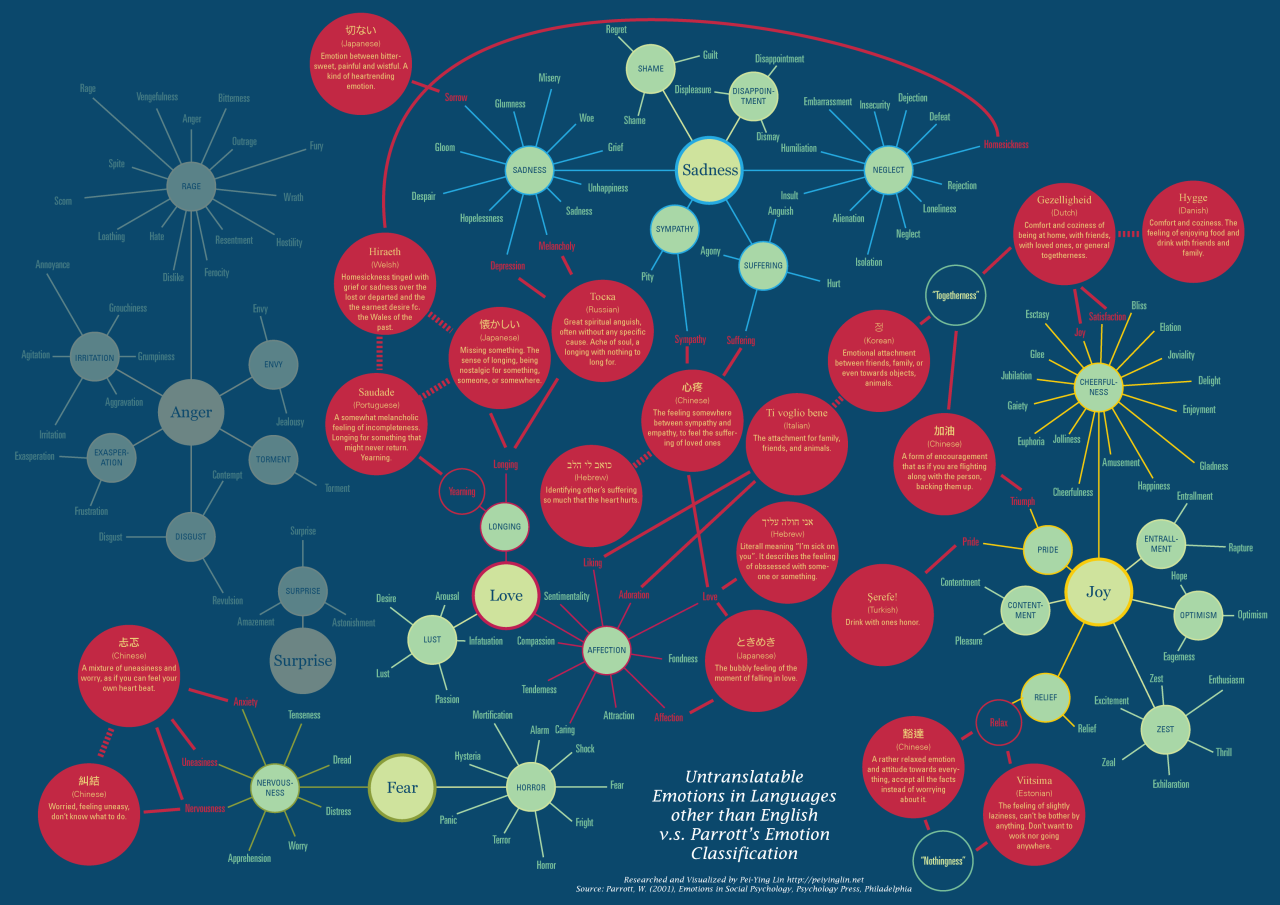
5. "Infographic Names 21 Emotions with No English Word Equivalents" (Erin McCarthy) (via). Large version of graph here. "Saudade" seems especially useful.


7. I want that drug! (Jon M)

29/12/2012

Operation Blank Slate, 2012 Edition

As usual, my end-of-the-year dump of stuff I meant to use for blogging but didn't. Shorter than usual because I changed machines mid-year and, much in the spirit of this series, didn't export bookmarks.

And coming on Jan 1st: The best blog posts of 2013.